
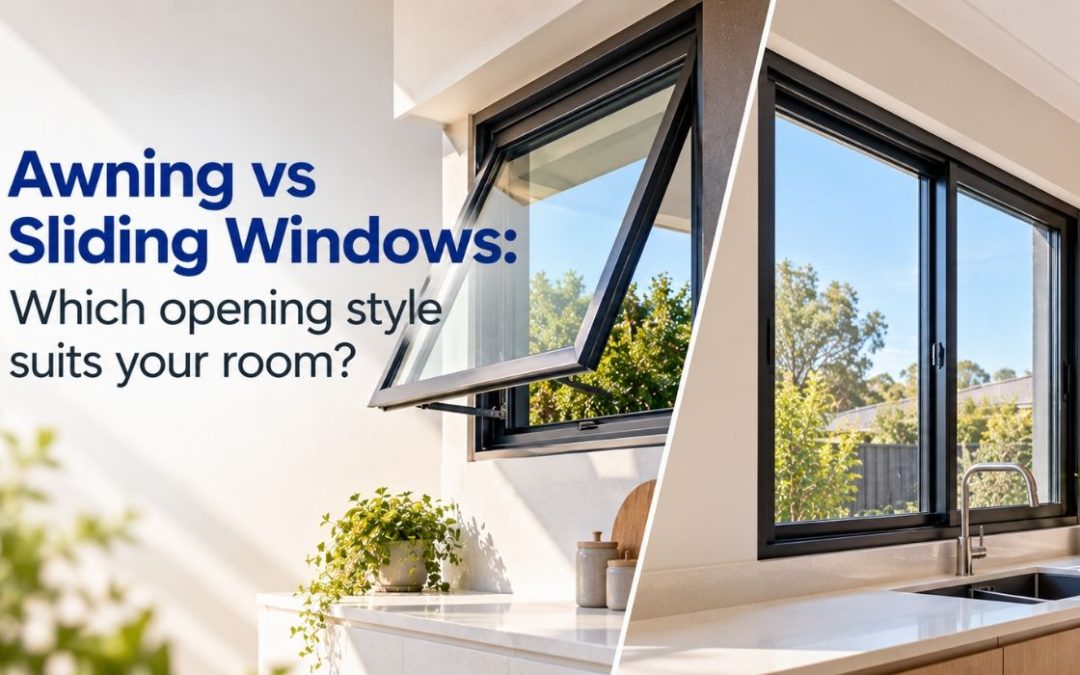
Choosing between awning and sliding windows is less about which design looks better and more about how the room needs to work. One style can help keep some rain out while open; the other can provide a wider, unobstructed opening without projecting beyond the wall. Those differences affect ventilation, furniture placement, outdoor clearances and everyday use.
Both styles are available in aluminium and can suit Australian homes. The right choice depends on the opening size, the direction of prevailing breezes, exposure to rain, the space outside the window and the glazing specified for the project.
As a starting point, consider sliding windows where you want a broad horizontal opening and do not want a sash projecting outdoors. Consider awning windows where controlled ventilation during light rain, a high-level opening or operation above a benchtop is useful. Neither is automatically the best option for every room.
How awning and sliding windows open
Awning windows
An awning window is hinged along the top and opens outward from the bottom. A chain winder or similar operator controls the sash. When open, the angled sash sits above the opening and can shelter it from some direct rainfall. This makes the style useful in locations where a small amount of ventilation is wanted during unsettled weather.
The trade-off is the size and shape of the opening. The sash remains across the airflow path, and the window needs room outside to swing open. YourHome notes that awning windows generally have a smaller maximum opening area than sliding windows and are less effective at drawing in incoming breezes unless the breeze is strong.
Sliding windows
A sliding window uses one or more sashes that move horizontally along tracks. In a common two-panel arrangement, one panel moves behind the other, leaving an open section while the remaining panel stays fixed. The sash does not swing into a deck, pathway or garden space, which can make sliding windows easier to use beside narrow external areas.
The available opening depends on the number of panels and the system design. A standard two-pane configuration usually leaves part of the frame closed, but the opening can still be wider than the one created by many awning configurations. Sliding windows are also a practical option where a wide horizontal view or a servery-style opening is wanted.
Awning vs sliding windows: key differences
| Factor | Awning window | Sliding window |
| Opening movement | Top-hinged sash opens outward from the bottom. | Sash moves sideways along a track. |
| Typical openable area | About 20–30% for a typical two-pane window in YourHome’s guide; varies by height and operator. | About 45% for a typical two-pane window in YourHome’s guide; varies by configuration. |
| Incoming airflow | Smaller opening; sash can restrict incoming breezes. | Generally provides a larger direct opening in a standard two-pane arrangement. |
| Light rain | Angled sash can shelter the opening from some rainfall. | The open section is more directly exposed to rain. |
| External clearance | Needs clearance for the sash to project outward. | No outward swing, so useful beside paths and outdoor areas. |
| Operation | Winder or chain operator; useful where a direct reach to the sash is difficult. | Push-and-slide operation; rollers and tracks need to stay clean. |
| Sealing | Compression-style seals can reduce air leakage when correctly designed and fitted. | Sliding seals and rollers vary by system; compare the tested window rather than assuming all sliders perform alike. |
| Typical room fit | Bathrooms, laundries, high-level openings and some kitchen locations. | Living areas, bedrooms, wide openings and openings beside decks or paths. |
The opening-area figures are indicative, not a promise about every window. YourHome gives maximum opening figures of 20–30% for awning windows and 45% for sliding windows in a two-pane example, with the awning figure depending on window height and the operator mechanism. These figures describe the proportion of the frame that can open; they are not a direct measurement of air volume delivered into a particular room.
Which window style suits each room?
Bathroom and ensuite
An awning window can be a useful choice where the opening needs to sit above eye level or where some ventilation during light rain is desirable. Obscure glazing can provide privacy while still admitting daylight. However, a smaller awning opening may not provide enough ventilation on its own, so plan for an appropriately sized, externally ducted exhaust fan where required. YourHome identifies exhaust fans vented outdoors as a reliable way to control moisture in kitchens and bathrooms.
Kitchen
The position of the window matters as much as its opening style. Above a sink or benchtop, an awning window with a reachable winder may be easier to operate than a sash that has to be pushed sideways. Where the kitchen opens to an alfresco area, a sliding window may be more suitable for a wider servery-style opening. Check handle reach, splash exposure, external clearance and how the window will be cleaned.
Laundry
An awning window can provide some ventilation while offering a degree of shelter from light rain. A sliding window may be preferable where a larger opening is needed or where an awning sash would project over a side path. If the room contains a dryer, make sure the overall ventilation plan addresses heat and moisture rather than relying on the window alone.
Bedroom
A sliding window is worth considering when the priority is a larger open section for everyday ventilation. An awning window can suit a bedroom where the opening is high, where the winder is easier to reach, or where some rain protection while open is useful. Consider the location of the bed, curtains, flyscreens, window locks and any fall-prevention requirements before choosing the configuration.
Living and dining areas
Sliding windows often work well in living areas because they can provide a broad horizontal opening and keep the sash within the frame. This is particularly useful beside an outdoor entertaining area, balcony or walkway where an outward-opening sash could get in the way. For a room that needs stronger cross-ventilation, compare the actual openable area and the position of other doors and windows, not just the width of the glass.
Hallways and high-level openings
An awning window can be practical when the operator is easier to use at a high level or when an opening is intended to let warmer air escape. YourHome notes that awning windows can assist with air exiting a building when each sash can open sufficiently, while they are less effective at drawing in incoming breezes. The opening angle and the wider ventilation design should be checked for the specific room.
Six things to check before choosing
1. Space outside the window
An outward-opening awning sash needs clearance. Check for a narrow side passage, a deck balustrade, external blinds, planting, fencing and any area where someone may walk close to the window. A sliding window avoids that outward projection and can be easier to position beside a frequently used outdoor space.
2. The ventilation the room actually needs
Do not judge ventilation by glass size alone. The useful opening area, wind direction, room depth, internal doors and the position of other openings all influence air movement. YourHome recommends designing multiple flow paths and positioning openings so air moves through the areas people use. Opposite or adjacent openings can help create cross-ventilation when site conditions allow.
3. Rain and weather exposure
An awning sash can act as a small canopy and reduce direct rain entry during light showers. It should not be treated as a guarantee that the room will remain dry in heavy or wind-driven rain. The performance of a closed window also depends on the frame, seals, drainage, hardware, installation and the product’s tested rating.
4. Glazing, shading and thermal comfort
The opening mechanism does not decide a window’s energy performance by itself. Glass type, frame construction, window size, orientation, shading and air seals all contribute. For Adelaide, YourHome includes the city among its examples of temperate climates and explains that glazing selection should account for orientation and shading as well as the window system.
When comparing products, ask for the whole-window U-value and solar heat gain coefficient (SHGC), rather than relying on a general claim that awning or sliding windows are more efficient. Where available, check the product’s Window Energy Rating Scheme (WERS) information. YourHome explains that WERS provides system-level details including U-value, SHGC, air infiltration and visible light transmittance.
5. Cleaning and maintenance access
Sliding windows need tracks and rollers kept free of dust and debris so the sash continues to move smoothly. Awning windows have hinges, winders and seals that should be inspected and operated as intended. Think about whether the outside glass can be safely reached, especially on an upper floor, before settling on a style.
6. Safety, screens and hardware
Check how the window will be secured when closed and whether a restrictor, lock or screen is needed when it is partly open. The applicable requirements depend on the building, opening location and current regulations. YourHome notes that the National Construction Code includes fall-prevention provisions for certain openable windows, so project-specific requirements should be confirmed with the building designer or relevant professional.
Options available through Alum Windows
Alum Windows lists both awning and sliding aluminium windows in its Adelaide range. Its awning window page describes chain-winder operation, an optional restricted winder and high-performance screen options. Its sliding window page describes a commercial-grade roller system, optional vent locks, anti-lift blocks, built-in weather flaps and a choice of sill options. These are published product-page details; confirm the exact hardware, size, glazing and performance available for the model being specified.
Explore the Alum Windows awning window range and the Alum Windows sliding window range to compare the configurations listed for each style.
Frequently asked questions
Do sliding windows provide more ventilation than awning windows?
A typical two-pane sliding window has a larger maximum openable area in YourHome’s comparison: about 45%, compared with 20–30% for an awning window. Actual ventilation still depends on the breeze, room layout, opening size and where other windows or doors are positioned. [1][3]
Can awning windows stay open when it rains?
The outward-opening sash can shelter the opening from some direct rainfall, so it may allow ventilation during light rain. It is not a guarantee against water entering during heavy or wind-driven rain. Close the window when conditions require it.
Are awning windows better for bathrooms?
They can be useful where privacy, high-level placement or ventilation during light rain matters. Choose suitable glazing and plan mechanical extraction as well; an openable window should not be the only moisture-control measure in every bathroom.
Are sliding windows better beside a deck or narrow path?
They can be more practical because the sash moves within the frame instead of projecting outward into the space. Check the full window dimensions, handle access and nearby furniture or structures.
Which style is more energy efficient?
Neither style is automatically more efficient. Compare the whole-window U-value, SHGC, air infiltration and glazing specification, and consider orientation and shading. The actual product system matters more than the style name.
Can a home use both awning and sliding windows?
Yes. A mixed approach can make sense: for example, awning windows in a bathroom or laundry and sliding windows in bedrooms or living spaces. Select each window for the room’s ventilation, clearance and weather requirements.
Choose by room, not by trend
Awning windows are useful where a controlled opening, high-level operation or some shelter from light rain is valuable. Sliding windows are practical where a wider opening and no outward swing are more important. For many homes, the best result is a combination of both.
Before making a final selection, consider the room layout, outside clearance, ventilation path, glazing performance and hardware. You can then compare the available awning window options and sliding window options from Alum Windows and discuss the sizes and configurations suited to your project.