
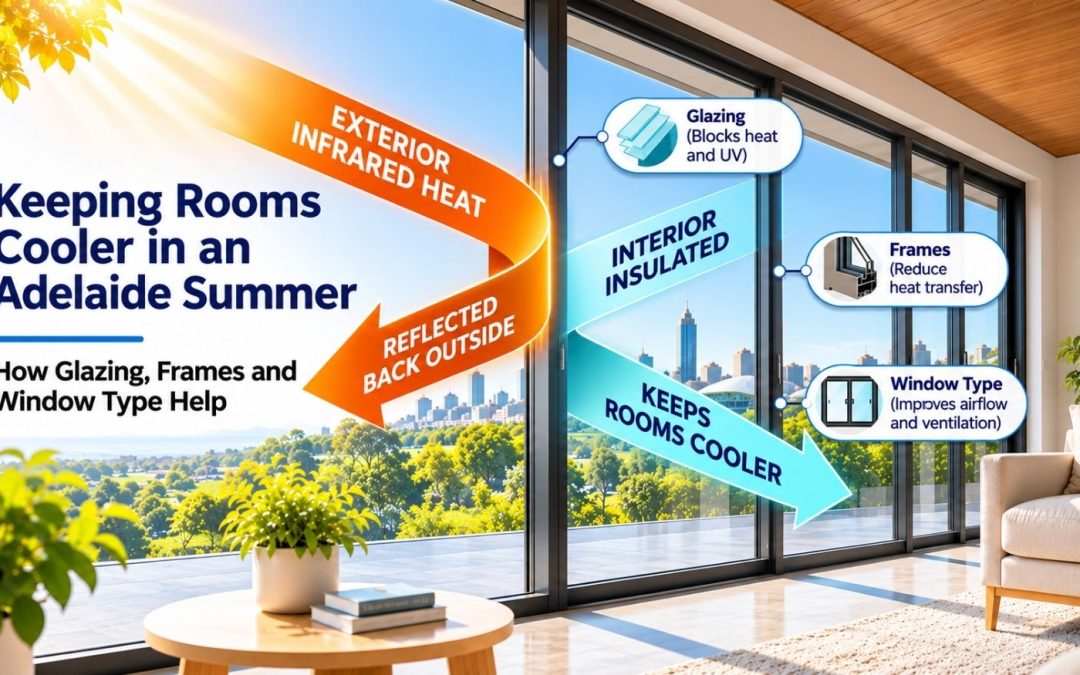
A room can feel noticeably hotter than the rest of the house when afternoon sun falls directly on its windows. The glass admits solar energy, which is absorbed by floors, walls and furniture and then released into the room. Large windows, exposed west-facing glass and limited external shade can make the effect more pronounced.
The solution is not simply to choose double glazing or install a different style of window. A cooler room depends on how the glass, frame, opening design, orientation and shading work together. In Adelaide, where homes need to manage both summer heat and cooler winter conditions, the aim is to reduce unwanted summer heat without making the home unnecessarily dark or sacrificing useful winter sunlight.
Start by controlling the sun before it reaches the glass
External shading is one of the most direct ways to reduce solar heat entering through a window. Eaves, awnings, pergolas, external blinds, adjustable louvres and well-positioned planting can intercept sunlight before it strikes the glass. Internal curtains and blinds still help, but they act after sunlight has passed through the window.
YourHome’s Australian shading guidance explains that suitable shading can block unwanted summer sun while allowing useful winter sunlight. The best arrangement depends on the direction the window faces. A fixed overhang that works well above a north-facing window may do little to stop low-angle afternoon sun entering from the west.
For Adelaide homes, look at each elevation separately rather than applying the same shading solution to every window.
How window orientation affects summer heat
| Window direction | Summer consideration | Practical design response |
| West-facing | Low-angle afternoon sun can strike the glass when outdoor temperatures are already high. | Prioritise external vertical shading, adjustable external blinds, a suitable veranda or pergola, and careful control of glazing area. |
| East-facing | Morning sun can create heat gain earlier in the day, particularly in bedrooms and living spaces. | Consider external blinds, vertical shading or planting that filters direct sun without blocking useful airflow. |
| North-facing | North-facing glass can receive useful winter sun but still needs seasonal control in summer. | Use appropriately designed eaves or horizontal shading to limit high summer sun while retaining winter solar access where the design allows. |
| South-facing | Often receives less direct solar heat than east- and west-facing glass, but the result depends on nearby buildings, reflected light and site conditions. | Assess daylight, exposure and ventilation. Do not assume every south-facing room will remain cool. |
The main lesson is that west-facing glass deserves particular attention in a hot afternoon room. Reducing direct sun with an external device can be more useful than relying on a darker internal blind after the glass has already heated up. YourHome recommends keeping east- and west-facing glazing appropriately shaded because low-angle sun is harder to control with simple horizontal overhangs.
For a new build, orientation and window size can be considered before the design is finalised. In an existing home, external shading, window coverings and selective window upgrades may offer more practical options.
Choose glass for both solar heat gain and insulation
Glass affects how much heat moves through a window, but two different measurements help explain its performance. They should be considered together rather than choosing glass based on a label such as ‘double glazed’ or ‘tinted’.
Solar Heat Gain Coefficient (SHGC)
SHGC measures how much solar heat passes through the complete window, including the glass and frame. It is expressed as a number between zero and one. A lower SHGC means less solar heat is transmitted indoors. This can be useful for a window that receives strong summer sun, although the preferred value depends on orientation, shading and the home’s winter heating needs.
Whole-window U-value (Uw)
The U-value measures how readily heat transfers through the complete window. A lower whole-window Uw means better resistance to heat flow. It is relevant in summer as well as winter: it helps limit heat transfer when outdoor and indoor temperatures differ. Ask for the whole-window value, not just a figure for the glass alone.
Visible light transmittance (VLT)
VLT describes how much visible daylight passes through the glazing. A glass choice that cuts solar gain may also reduce daylight, depending on its coating or tint. Consider the room’s need for natural light and views when comparing options.
The Australian Government’s YourHome guide explains these measures and shows why a window must be assessed as a complete assembly. WERS information can help compare the heating and cooling performance of specific window systems. Make sure any rating supplied relates to the exact frame, glass, size and opening configuration being quoted.
Does double glazing automatically keep a room cooler?
No. Double glazing can reduce heat transfer through the window, but the result depends on the glass combination, cavity, frame and solar exposure. A clear double-glazed unit may still allow substantial solar heat gain if it has a relatively high SHGC and receives direct sun.
Low-emissivity (low-E) glass uses a very thin coating to alter heat transfer. Different low-E products are designed for different purposes: some retain useful solar heat while reducing heat loss, while solar-control options reduce the amount of solar heat entering. Toned or other solar-control glass can also change SHGC and daylight transmission.
For a west-facing room that overheats in summer, ask the supplier or designer whether a lower-SHGC option is appropriate and what effect it will have on daylight and winter performance. Do not assume that the same glass specification is ideal for every side of the home.
Alum Windows has published glass options that include single and double glazing, e-glass, laminated and thickened glass. Its website says the team can help work towards a specified U-rating. Confirm the exact glass build-up and whole-window performance available for the proposed system. For a fuller explanation of the pros, limitations and costs of double glazing in Adelaide, see the existing guide: [Double Glazing in Adelaide: Where It Pays Off and Where It May Not](https://alumwindows.com.au/double-glazing-adelaide/).
The aluminium frame matters too
Aluminium is strong, durable and widely used in residential and commercial window systems. It is also a good conductor of heat. In a standard aluminium frame, heat can travel through the frame as well as through the glass, which can reduce the insulating performance of the complete window.
A thermally broken aluminium frame uses an insulating barrier between the inner and outer aluminium sections to interrupt that direct path. This can reduce heat transfer through the frame. However, not every aluminium window is thermally broken, and the term should not be assumed from the material name or from the fact that a window is double glazed.
When comparing products, request the whole-window Uw and SHGC for the specific configuration. Ask whether the frame is thermally broken and whether the supplied performance figures apply to the actual dimensions, opening style and glass combination. A strong glass specification cannot be judged separately from the frame that holds it.
Alum Windows’ website describes its aluminium systems, custom configurations and glass choices, but the public pages reviewed do not publish WERS ratings for every configuration or confirm that all frames are thermally broken. Ask the team for the technical information relevant to the system being considered. The separate guide [Aluminium vs Timber Windows in Adelaide](https://alumwindows.com.au/aluminium-vs-timber-windows-adelaide/) explains the wider frame-material comparison.
Window type: consider how the room needs to ventilate
Window style affects how a room can be opened to the outside. It does not, by itself, determine whether the room will stay cool. The useful question is how much of the opening can be used, where the opening is positioned and whether air can move through the room.
- Awning windows are hinged at the top and open outward from the bottom. Their opening arrangement can provide controlled ventilation, but the effective opening area and airflow depend on the specific size and hardware.
- Sliding windows move horizontally within the frame. They provide a straightforward opening, although only part of the overall window area may be open at one time.
- Double-hung windows use vertically moving sashes. Opening both the upper and lower sections can support air movement, subject to the product design and opening limits.
- Bi-fold window systems can create a wider opening when multiple panels are folded back. The available opening, panel arrangement and weather exposure need to be checked for the project.
A room is more likely to benefit from natural ventilation when there is a useful path for air to enter and leave. Openings on different sides of a room or building can support cross-ventilation when outdoor conditions and wind direction are suitable. A single open window may provide less effective air movement if there is no clear outlet.
The best opening style depends on the room layout, access, weather exposure, security and how the occupants intend to use the space. Alum Windows lists awning, sliding, double-hung and bi-fold window options. Compare the actual opening dimensions and operating details rather than choosing by style name alone. For a closer comparison, read [Awning vs Sliding Windows: Which Opening Style Suits Your Room?](https://alumwindows.com.au/awning-vs-sliding-windows/).
When should you open or close windows during hot weather?
Window ventilation is useful when the outside air is cooler than the air inside. In South Australia, the state government’s home-cooling advice recommends opening doors and windows when it is cooler outside at night to let cooler breezes move through the home. During the hotter part of the day, keep direct sun off windows and use internal coverings to limit heat entering.
If you are running a conventional refrigerative air conditioner, keep windows and external doors closed while cooling the room. Opening them allows cooled air to escape and hot air to enter. Evaporative cooling works differently and needs ventilation, so follow the cooling system manufacturer’s instructions.
A practical routine is to shade exposed windows before direct sun reaches them, keep the home closed while outside air is hotter than inside, then use secure openings to ventilate when evening or overnight conditions become cooler. The right timing varies with the day’s weather, the home’s layout and local breezes.
Security matters when windows are left open. A suitable security screen or lockable screen door can help provide ventilation while maintaining a barrier, but check the product’s intended use and security performance. Alum Windows publishes a range of security doors and screens; confirm the configuration suitable for the relevant opening.
Do not overlook seals, curtains and the rest of the building
Even a well-selected window can underperform if there are gaps around the frame or the surrounding building envelope is poorly sealed. Draughts can make temperature control harder and allow conditioned air to escape. Check for moving curtains, whistling, rattling or noticeable air movement around closed windows and doors.
Close-fitting curtains or blinds with a light-coloured block-out backing can help reduce summer heat entering through the window. Close them before direct sunlight reaches the glass. External shading remains valuable because it blocks direct sun before it reaches the window.
Windows are only one part of a home’s heat load. The South Australian Government also highlights ceiling and wall insulation, draught sealing and shading as practical cooling measures. If a room remains hot after the windows are shaded, check the roof space, insulation, wall exposure and air leakage rather than assuming the glass is the only cause.
A practical checklist before choosing new windows
Before requesting a quote or finalising a window schedule, work through these questions for each room:
- Which direction does the window face, and when does direct sunlight reach it?
- Is external shading already in place? If not, could an awning, eave, pergola, external blind or planting reduce direct sun?
- What are the whole-window Uw and SHGC values for the proposed frame and glass combination?
- Is the aluminium frame standard or thermally broken? What evidence supports the stated performance?
- How much visible daylight will the glass transmit?
- What opening area is available, and can air move through the room when conditions are suitable?
- Are the seals, drainage paths, hardware and installation details appropriate for the exposure?
- Does the selected system meet the requirements that apply to the project? Confirm this with the designer, energy assessor, supplier or building certifier.
- Are the quoted glass, frame, finish, hardware, warranty and installation details recorded in writing?
This room-by-room approach is more useful than specifying the same glass and window style throughout a home without considering orientation or how each space is used.
How Alum Windows can help with your project
Alum Windows supplies custom aluminium windows and doors for residential, semi-commercial and commercial projects across Adelaide. Its published range includes awning, sliding, double-hung and bi-fold windows, along with aluminium doors and security screens. The company states that it manufactures at its Edinburgh, South Australia facility and works with Alspec aluminium extrusions.
The website describes a range of glass options, custom sizes and configurations, anodised or powder-coated finishes, customisable hardware and technical support. It also states that windows and doors are backed by a seven-year manufacturer’s warranty. Product options and performance depend on the selected system, so confirm the exact specification, relevant ratings and written warranty terms for your project.
If you are planning a new build or replacing existing windows, explore the [Alum Windows aluminium window range](https://alumwindows.com.au/aluminium-windows-adelaide/) and discuss the room orientation, shading, glass and opening requirements with the team. You can also review the [aluminium doors range](https://alumwindows.com.au/aluminium-doors-adelaide/) if large glazed door openings are part of the design.
Frequently asked questions
What is the best glass for keeping a room cool in Adelaide?
There is no single best glass for every window. A lower-SHGC option can reduce direct solar heat gain, particularly on exposed east- and west-facing windows. Compare SHGC with whole-window Uw and visible light transmission, and consider the room’s winter heating needs.
Are aluminium windows suitable for hot weather?
Yes, aluminium is widely used because it is strong and durable, but it conducts heat readily. The glass, frame design, seals, shading and installation all affect the complete window’s performance. Ask for whole-window performance figures for the exact configuration.
Will double glazing stop summer heat?
Double glazing can reduce heat transfer, but it does not automatically block strong solar gain. The glass coatings, SHGC, frame and external shading also matter. Choose the complete window specification for the room’s orientation and use.
Should west-facing windows be shaded in Adelaide?
West-facing windows often need careful summer shading because they receive low-angle afternoon sun. External blinds, vertical shading, verandas or pergolas can help reduce direct sunlight before it reaches the glass.
Is it better to open windows during the day or at night?
Open windows when the outside air is cooler than the indoor air and conditions allow useful ventilation. During hotter periods, shade the windows and keep them closed if using refrigerative air conditioning. Evaporative cooling requires ventilation.
How can I compare the thermal performance of aluminium windows?
Ask for the whole-window U-value and SHGC for the exact frame, glass, size and opening type. Check whether the frame is thermally broken and whether the performance information is supported by WERS or other recognised evidence.
Does Alum Windows offer different glass options?
Alum Windows’ website lists single and double glazing, e-glass, laminated and thickened glass options. Confirm availability and the technical performance of the proposed combination with the team.
A cooler room starts with the complete window design
Keeping an Adelaide room comfortable through summer is rarely a matter of choosing one type of glass or one window style. External shading, orientation, SHGC, whole-window U-value, frame construction and ventilation all play a part. Start by identifying when the room receives direct sun, then compare the window options against the conditions at that opening.
For a new build or renovation, ask for the performance details of the complete window and make sure the glass, frame and opening arrangement suit the room. To discuss custom aluminium windows and doors for an Adelaide project, Visit the Alum Windows product range or contact the team